We detected 2,352 companies using Accessibly and 62 customers with upcoming renewal in the next 3 months. The most common industry is Retail (61%) and the most common company size is 2-10 employees (69%). We find new customers by detecting JavaScript snippets or configurations on customer websites.
The count of new companies shown here may differ from the total in the table above. This is intentional. We apply a consistent baseline to ensure month-over-month comparisons are apples-to-apples rather than affected by when data was first collected.
Loading trends...
No trend data available for this vendor.
Market Insights
🏢 Top Industries
Retail1353 (61%)
Retail Apparel and Fashion131 (6%)
Food and Beverage Services77 (3%)
Manufacturing69 (3%)
Personal Care Product Manufacturing64 (3%)
📏 Company Size Distribution
2-10 employees1611 (69%)
11-50 employees411 (18%)
51-200 employees195 (8%)
201-500 employees56 (2%)
501-1,000 employees18 (1%)
📊 Who usually uses Accessibly and for what use cases?
Source: Analysis of job postings that mention Accessibly (using the Bloomberry Jobs API)
Job titles that mention Accessibly
i
Based on an analysis of job titles from postings that mention Accessibly.
Job Title
Share
Director, Business Development
14%
Director, Analytics
7%
Vice President, Business Development
4%
Director, Information Technology
3%
My analysis shows that Accessibly buyers are split across two primary domains. Business development directors (14%) lead the purchasing charge, focused on expanding market reach and generating revenue. Analytics directors (7%) represent the data-driven decision makers who need accessible insights to inform strategy. Leadership roles span business development, IT, product management, and research functions, all seeking to make their organizations' offerings and data "accessibly" available to broader audiences.
The day-to-day users appear to be product managers, designers, engineers, and data analysts who need to present information clearly across stakeholder groups. Multiple postings emphasize creating experiences that are "accessible" and "inclusive," transforming complex data into formats that diverse audiences can understand. Teams using Accessibly seem focused on democratizing access to information, whether that's economic data, business intelligence, research findings, or product features.
Three critical pain points emerge consistently. First, organizations want to make information "accessibly" available while maintaining quality and accuracy. Second, there's a strong emphasis on "inclusive" and "transparent" communication that reaches diverse stakeholders. Third, companies are trying to "translate complex data into actionable insights" and present findings "clearly and accessibly in the form of reports." These phrases reveal organizations struggling to bridge the gap between sophisticated analysis and practical, understandable outputs that drive decisions across technical and non-technical audiences alike.
👥 What types of companies use Accessibly?
Source: Analysis of Linkedin bios of 2,352 companies that use Accessibly
Company Characteristics
i
Shows how much more likely Accessibly customers are to have each trait compared to all companies. For example, 2.0x means customers are twice as likely to have that characteristic.
Trait
Likelihood
Industry: Cosmetics
27.8x
Industry: Retail Apparel and Fashion
22.4x
Industry: Personal Care Product Manufacturing
22.3x
Funding Stage: Series unknown
5.2x
Funding Stage: Private equity
4.8x
Funding Stage: Series A
4.7x
I noticed that Accessibly's customers are predominantly retail and direct-to-consumer brands selling physical products. These companies span fashion and jewelry, beauty and skincare, food and beverage, sporting goods, home goods, and specialty retail. They're not tech companies or pure service businesses. They make things people touch, wear, eat, or display in their homes. Many sell through both physical locations and e-commerce, with a strong emphasis on online presence.
These companies skew small to mid-sized. Most have employee counts under 50, with many in the 2-10 range. They're past the earliest startup phase but still growing, what I'd call scaling challengers rather than established giants. The few larger companies (like Larsen & Toubro or UBA Group) seem to be outliers. Funding information is sparse, suggesting most are bootstrapped or traditionally financed rather than venture-backed. They've moved beyond proof-of-concept but haven't reached enterprise scale.
🔧 What other technologies do Accessibly customers also use?
Source: Analysis of tech stacks from 2,352 companies that use Accessibly
Commonly Paired Technologies
i
Shows how much more likely Accessibly customers are to use each tool compared to the general population. For example, 287x means customers are 287 times more likely to use that tool.
I noticed something really clear in this data: Accessibly users are predominantly direct-to-consumer e-commerce brands built on Shopify. The combination of Shopify as the core platform with Klaviyo for email marketing, Recharge for subscriptions, and Route.com for package tracking tells me these are consumer product companies selling physical goods online with recurring revenue models.
The pairing of Gorgias and Attentive is particularly revealing. Gorgias is a customer support platform designed specifically for e-commerce, while Attentive handles SMS marketing. Together with Klaviyo's email capabilities, this suggests companies that are heavily focused on direct customer communication across multiple channels. They're not just selling products, they're building relationships through personalized messaging. The Recharge integration adds another layer: these brands are likely selling consumables or products that benefit from subscription models, like beauty products, supplements, or pet food.
My analysis shows these companies operate with a marketing-led growth strategy. The emphasis on Klaviyo, Attentive, and customer communication tools indicates they acquire customers through digital marketing and then maximize lifetime value through retention tactics. Route.com's presence suggests they care deeply about post-purchase experience and reducing friction around shipping issues. These are likely mid-market DTC brands that have moved past the startup phase and are optimizing for customer retention and operational efficiency.
Alternatives and Competitors to Accessibly
Explore vendors that are alternatives in this category
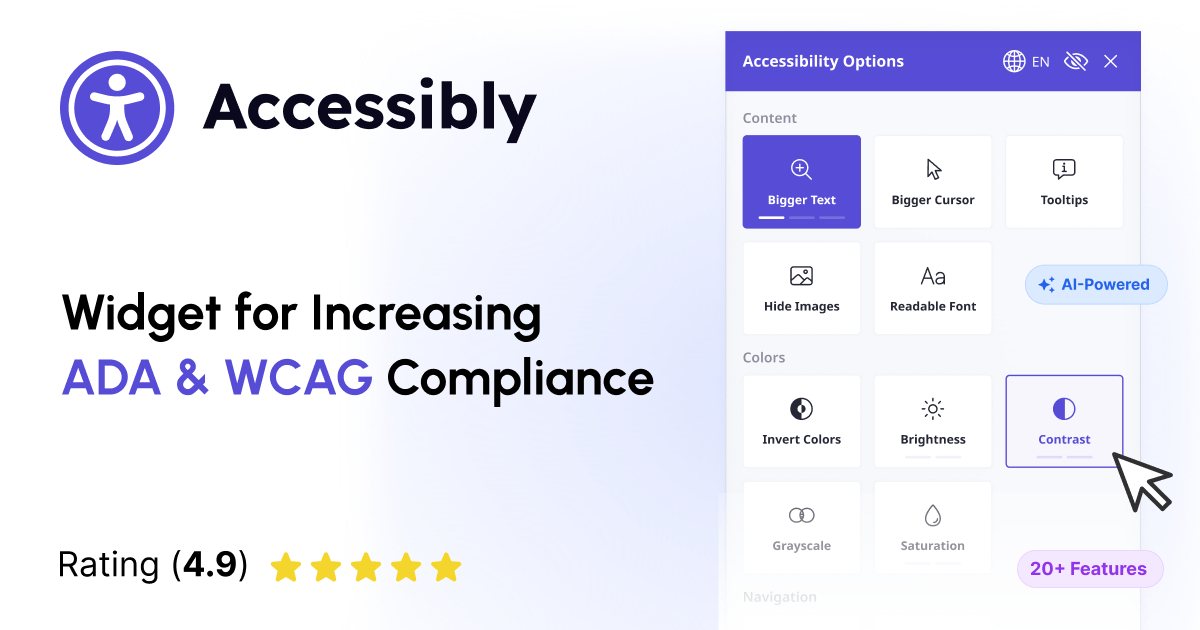 We detected 2,352 companies using Accessibly and 62 customers with upcoming renewal in the next 3 months. The most common industry is Retail (61%) and the most common company size is 2-10 employees (69%). We find new customers by detecting JavaScript snippets or configurations on customer websites.
 Caseys Furniture
 Absolutely Ridiculous
 Lanshin
 The Sydney Teacher
 Modelones
 Make Time Wellness
 LeafWorks
 GLOBAL HOME FURNISHING LTD
 eraclea skin care
 Eagle National Supply
 SuperX
 Presbyterian Villages of Michigan
 Shop BBJ
 Horans Healthstore
 Yeah It's Jewelry
 CANOPY ROAD CAFÉ
 RESA
RESA
 The Perfect Light
 Cuadra


