Where does your data come from, and how is it different from BuiltWith, Wappalyzer or TheirStack?
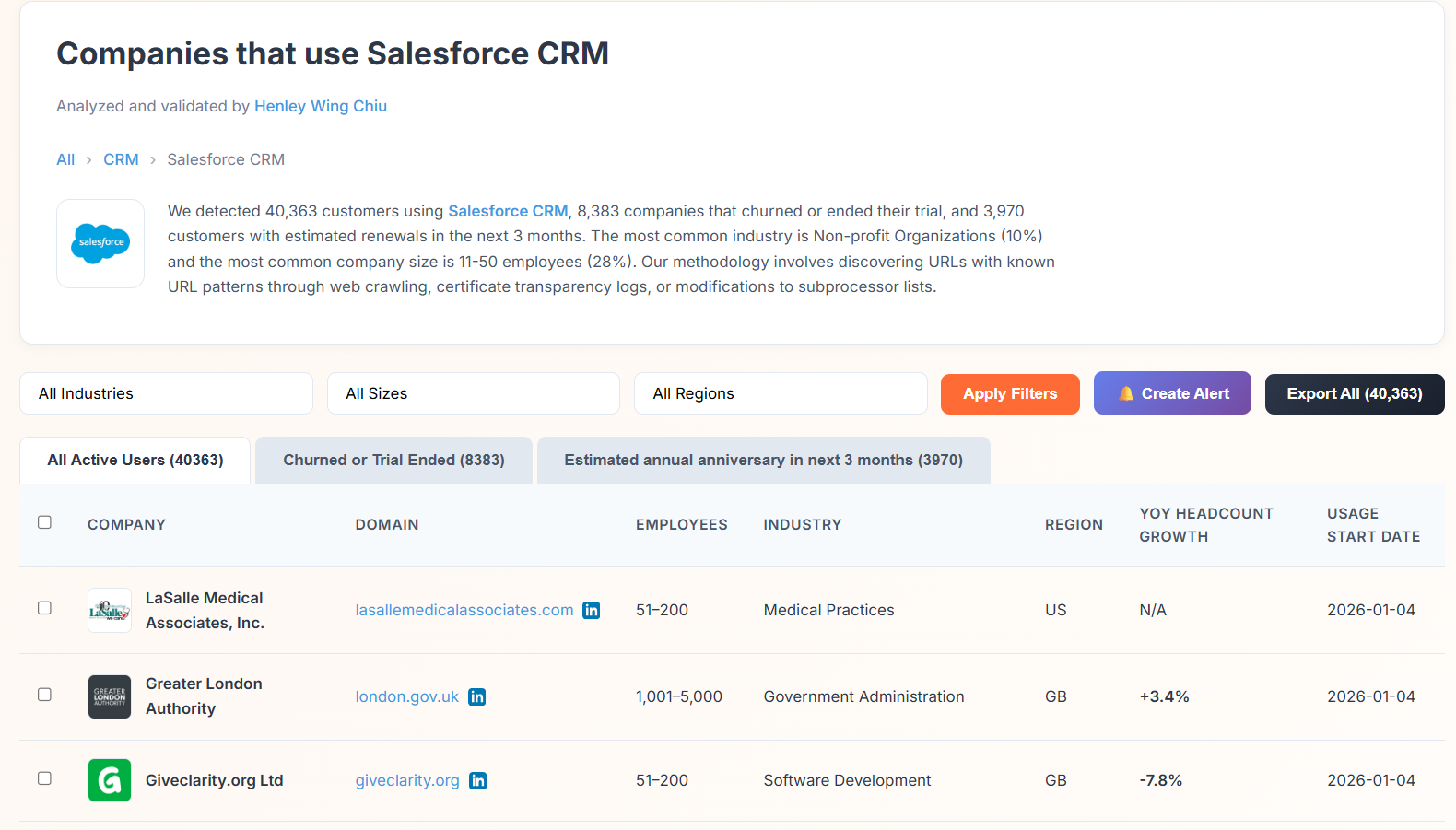
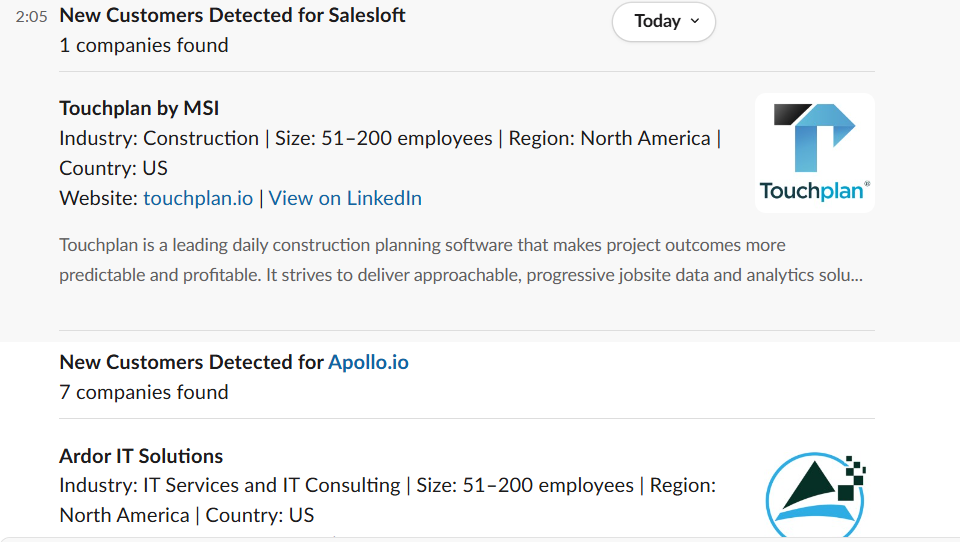
Bloomberry tells you which companies just started or stopped paying for any of 1,700+ B2B products. It reads infrastructure signals - what a company sets up when it buys software - rather than website tags or job postings.
Concretely, that means new subdomains, DNS records, certificate transparency logs, and signals specific to how each individual product gets deployed. We crawl websites too, but we go further than checking whether a tag exists - we read the configuration inside script files and check whether they still return a working response. We've built a separate detector for each of the 1,700+ products we cover, so we know what that particular product looks like when it's set up, and we can confirm when it's gone. That's why we can tell you when a company subscribed or churned, not just what's on their website today.
Some of those signals only appear when a product is genuinely deployed. Rolling out an AI assistant or an ERP across an organization usually means verifying a domain for single sign-on or updating email records - public changes that a single seat or a free trial never produces. So when we report an adoption, it generally reflects a real organizational rollout.
Website scanning tells you presence, not timing, and skews toward front-end technologies. Job postings tell you what a company wrote in a job ad, which is why TheirStack scores how likely it is that the company actually uses what it mentioned. We don't use job postings, vendor case studies or product reviews - they're indirect and they lag.
Because we're not limited to website tags, we also cover backoffice products with no website footprint at all: AI products (ie ChatGPT, Claude, Cursor), CRMs (ie Salesforce and Hubspot), project management tools (Jira, Monday) and much more.
Why do you cover fewer products than BuiltWith or TheirStack?
Because we build a separate detection method for each product we cover. Depending on the vendor, that can mean watching for a new subdomain to resolve, reading DNS records, or checking a signal specific to how that one product works. Catalogs with tens of thousands of entries get there by running a single generic check across every JavaScript library, tag and framework on the internet - most of which nobody sells against. We cover the 1,700+ B2B products GTM teams actually build territory and displacement plays around, and for each one we tell you when a company started or stopped paying. We also don't call it churn just because a tag disappeared: we verify the endpoint is genuinely dead first, so a site redesign doesn't show up as a lost customer.
Can you tell me which companies just adopted AI tools?
Yes. We track adoption and churn for AI products the same way we track everything else, with dates attached - including ChatGPT, Claude, Cursor and others across our enterprise AI category. So you can ask questions like "which companies rolled out an AI coding tool in the last 90 days" rather than just "who has an AI vendor somewhere in their stack".
Do you cover newer tools, or just established ones?
Both, and we add new products continuously. We already track adoption for tools that launched recently - RB2B, Unify, Warmly and similar - alongside established categories like CRM and ERP. Legacy technographic databases are built around one fixed detection method, so newer GTM and AI tools tend to arrive late or not at all. If there's a product you need covered that we don't have yet, tell us and we'll usually add it.
How many of these subscribe/churn events do you uncover per month?
Our data consists of over 400,000 events every month.
What are the limitations of your data?
While we cover a wide range of categories, there are a few niches where we're not as strong such as edtech. In addition, we do not provide data on the person who was in charge of the purchase/churn event. We only provide data on the companies, not contact information of individuals.
Can I get a free trial?
Yes, please fill out this form and we'll email you login details.
 Claude
 Cursor
 Clay
Clay
 Unify
Unify
 RB2B
RB2B
 Attio
Attio
 Pylon
Pylon
 ElevenLabs
 Snowflake
 Rippling
 Vanta
Vanta
 MCP servers
 LiteLLM
 Resend