Bloomberry vs TheirStack
Looking for a TheirStack alternative? Both provide technographic data beyond website crawling, but they get it in fundamentally different ways. Here's what that means in practice.
Summary
Choose TheirStack if you want the widest possible catalog of technology names, or hiring activity as an intent layer. Choose Bloomberry if you need to know when a company actually started or stopped using a product, with a date attached - including developer and infrastructure tools, where deployments leave the clearest traces of all.
The short version: TheirStack answers what does this company mention in its job postings. Bloomberry answers which companies just started or stopped paying for this software.
Put another way: BuiltWith and Wappalyzer read websites. TheirStack reads job postings. Bloomberry reads infrastructure signals - what a company sets up when it buys software.
Notably, this is a different comparison from BuiltWith or Wappalyzer. TheirStack isn't a website crawler, and it does reach backend software that crawlers can't see. The difference here is inference versus detection - and what each approach can and can't tell you.
Feature Comparison
| Bloomberry | TheirStack | |
|---|---|---|
| 🔬 Data Source | Deployment traces: subdomains, DNS records, certificates, configuration changes, per-product detectors | Technology mentions extracted from job postings |
| 🎯 What You Get | Events with dates: subscribed, churned, renewal approaching | A likelihood that a company uses a technology, with a low/medium/high confidence score |
| 📊 Catalog Size | 1,700+ B2B products across 190 categories | 33,000+ technologies, including languages, libraries and frameworks |
| 📉 Churn Detection | Verified churn events with dates, after confirming the deployment is genuinely gone | First and last mention dates; a technology dropping out of job postings isn't necessarily churn |
| 🏢 Coverage Bias | Independent of hiring activity; a company that never posts a job is still covered | Depends on hiring activity; TheirStack notes that companies in hiring freezes or small teams that rarely post jobs may have less coverage |
| 🔎 Evidence | For much of our data, the specific URL, subdomain or record the detection came from | The job posting the mention was extracted from |
| 🔔 Alerts | Email and Slack alerts on adoption, churn and upcoming renewals | Alerts on new job postings and technology changes; webhooks available |
| 🔌 Access Method | Web app + REST API + Slack/email alerts | Web app + REST API + webhooks + datasets |
| 💼 Best For | Displacement plays, renewal timing, deployed developer and infrastructure tooling, and platforms embedding purchase/churn signals in their own products | Broad targeting by technology name, skills and languages, and hiring-based intent |
Key Differences Explained
1. Inference vs. Detection
TheirStack is transparent about how its data works, and that transparency is worth taking at face value. They extract technology mentions from job postings, link every signal back to the posting it came from, and apply a three-tier confidence model - low, medium, high - to estimate how likely it is that the company actually uses the technology, based on factors like mention volume, frequency and recency.
That confidence score exists because a job posting is evidence about a job posting. Job descriptions are typically written by recruiters, and they routinely list the entire stack a team touches, tools the company would like to adopt, and requirements copied from an older posting. A company might name a tool it's evaluating, one a single contractor used once, or one it's actively migrating away from.
The confidence score helps, but it scores mention patterns rather than usage. A tool that sits in boilerplate across every posting scores high whether or not anyone uses it, while a tool the company genuinely pays for and never hires for scores low, or doesn't appear at all.
Bloomberry reads infrastructure signals - what a company sets up when it buys software. Concretely: new subdomains, DNS records, certificate transparency logs, and signals specific to how each individual product gets deployed. We've built a separate detector for each of the 1,700+ products we cover, so we know what that product looks like when it's set up, and we can confirm when it's gone. Some of those traces only appear on a genuine rollout - deploying an AI assistant or an ERP across an organization usually means verifying a domain for single sign-on or updating email records, which a single seat or a free trial never produces.
Our signals are checkable too. For much of our data we surface the underlying evidence - the specific URL, subdomain or record the detection came from - so you can verify a detection yourself rather than taking a score on trust.
2. Churn: The Signal Job Postings Can't Produce
This is the sharpest difference, and it matters most if you sell against an incumbent.
TheirStack records when a technology was first and last mentioned. But a technology dropping out of a company's job postings doesn't mean they cancelled it. It usually means they stopped hiring for that role. A company can pay for Salesforce for a decade and never mention it in a job posting again after the first year. The absence of a mention isn't evidence of a cancellation.
Bloomberry reports churn as an event with a date, and only after verifying that the deployment trace is genuinely gone rather than merely dormant. That validation is why our churn signals take 1-2 weeks rather than appearing instantly - we'd rather be slightly slower than send you a false churn event.
3. Timing
TheirStack indexes job postings quickly, so a new posting appears in their data fast. But the date on the posting isn't the date of the purchase. A company might mention a tool while evaluating it, months before signing, or years after adopting it, whenever they next hire for that team.
Bloomberry's purchase signals typically appear within 3 days of the actual adoption, because the trace we're watching for is produced by the deployment itself. If you're building a play around timing - reaching out during an evaluation window, or before an auto-renewal locks the budget - the difference between "recently mentioned" and "started paying on this date" is the whole play.
4. Skills vs. Deployments
The useful split isn't developer tools versus business software. It's whether the thing is a skill or a deployment.
Job postings are the right source for skills. Python, React, Rust, "experience with distributed systems" - nobody deploys those, and nobody sells a subscription to them. If that's what you need to target, job-posting analysis is a reasonable approach.
But the moment a developer tool is something a company actually runs or signs up for, it leaves a trace - and deployed developer tooling leaves the clearest traces of any category we cover. We detect a self-hosted GitLab when the instance appears at a company's own subdomain. We pick up new n8n cloud tenants, new LiteLLM subdomains, new Hugging Face organizations, and over a million GitHub organizations, each through a detector built for that specific product.
This is where job postings are weakest, not strongest. Take LiteLLM: it's barely mentioned in job descriptions, because it isn't a hiring requirement - it's a component a team stands up. We track thousands of companies running it. A method that depends on someone writing the tool's name into a job ad will find almost none of them.
A posting saying "GitLab experience required" doesn't tell you when they deployed it, whether it's self-hosted or SaaS, or whether they still run it today. The subdomain resolving tells you all three.
The same holds at the other end of the stack. Most commercial SaaS never appears in a job description because nobody is hired for it - Intercom, ChatGPT, Slack, a particular expense tool. Those purchases are made by a department head and leave a deployment trace, not a hiring one.
5. Alerts on Purchases, Churn and Renewals
Both products offer alerting, but on different underlying events. TheirStack can notify you about new job postings and technology changes. Bloomberry alerts on the commercial events themselves.
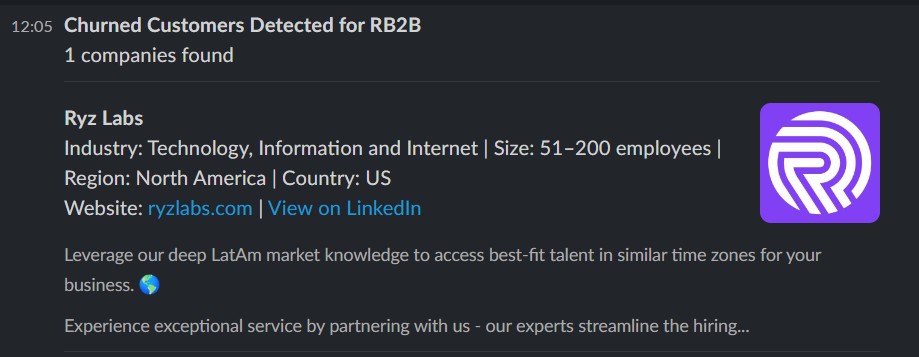
Bloomberry's Alerts feature sends notifications to your inbox or Slack channel whenever:
- A new customer signs up for a product you're tracking (useful for competitive displacement or partner outreach)
- A company churns from a product (timing to offer your alternative)
- A renewal is approaching (reach out before the auto-renew locks the budget)
Example Bloomberry Alert
6. Where TheirStack Wins
TheirStack's catalog is roughly twenty times the size of ours. For skills and languages - things that are never deployed and never sold as a subscription, like Python, React or "distributed systems experience" - job postings are the right source and we don't compete there at all.
Hiring signals are also a real intent layer that we don't provide. A company staffing up a revenue operations team is telling you something useful, and that's TheirStack's territory, not ours. Their entry pricing is lower than ours, and their free tier is generous enough for genuine evaluation.
And we have gaps worth knowing about. Our coverage is thinner in some niches, edtech most notably. We provide company-level signals only, with no contact data for the individuals behind a purchase. And our churn signals intentionally lag adoption signals by 1-2 weeks because we validate them first.
When to Choose Each Platform
Choose Bloomberry if you:
- ✓ Need verified churn events, not the absence of a mention
- ✓ Build plays around timing: displacement, renewals, evaluation windows
- ✓ Sell commercial SaaS that nobody posts a job requirement for
- ✓ Target companies regardless of whether they're hiring
- ✓ Are a platform embedding purchase and churn signals into your own product
Choose TheirStack if you:
- ✓ Target by skills and languages rather than deployed products
- ✓ Need the widest possible technology catalog
- ✓ Want hiring activity itself as an intent signal
- ✓ Want hiring context attached to every technology signal
- ✓ Need the lowest entry price
These aren't mutually exclusive. Several teams run both: TheirStack for breadth and hiring intent, Bloomberry for purchase and churn timing on the products they sell against.
A fair warning about pages like this one, including ours: vendor comparisons are written by the vendor. Both products have free tiers, so the honest test is to take 20-30 accounts whose stack you already know and see which one gets them right.
Ready to Try Bloomberry?
Real-time signals across 1,700+ B2B products in 190 categories. Track purchases, churn and renewals as they happen - in the app or through our API.
Start a Free Trial →Or browse our coverage, see pricing, or read the API docs.
Frequently Asked Questions
What's the main difference between Bloomberry and TheirStack?
TheirStack infers technology usage from mentions in job postings and applies a confidence score to estimate how likely it is that the company actually uses it. Bloomberry detects the deployment itself, from the public traces a product leaves when a company starts paying for it, and reports adoption and churn as dated events.
Does TheirStack detect churn?
TheirStack records when a technology was first and last mentioned in job postings. A technology no longer being mentioned doesn't necessarily mean the company stopped paying for it - it usually just means they stopped hiring for that role. Bloomberry detects churn by verifying the product's deployment trace has genuinely gone, and reports it as a dated event.
Why does Bloomberry cover fewer technologies than TheirStack?
TheirStack covers 33,000+ technologies because any technology named in a job posting can be indexed, including programming languages, libraries and frameworks. We build a separate detector for each product we cover, so our catalog is 1,700+ B2B products across 190 categories, focused on commercial software GTM teams actually sell against. If there's a product you need that we don't cover, tell us and we'll usually add it.
Which is better for finding companies using developer and infrastructure tools?
It depends whether the tool is a skill or a deployment. For languages and frameworks nobody deploys - Python, React, Rust - job postings are the right source and TheirStack covers them. For developer tools a company actually runs or signs up for, we detect the deployment itself: self-hosted GitLab instances on a company subdomain, new n8n cloud tenants, new LiteLLM subdomains, new Hugging Face and GitHub organizations. That tells you when it went live and whether it's still running, which a job posting can't.
Can I use both?
Yes, and several teams do. They serve different jobs: TheirStack for catalog breadth and hiring intent, Bloomberry for purchase and churn timing on the specific products they sell against. Both offer free tiers, so you can test them side by side on accounts you already know.
Is Bloomberry more expensive than TheirStack?
TheirStack's entry pricing is lower than ours. Our published plans start at $199 per month for app or API access, with a free trial and no credit card required - see our pricing page. Custom plans are available for platforms integrating our data into their own products.