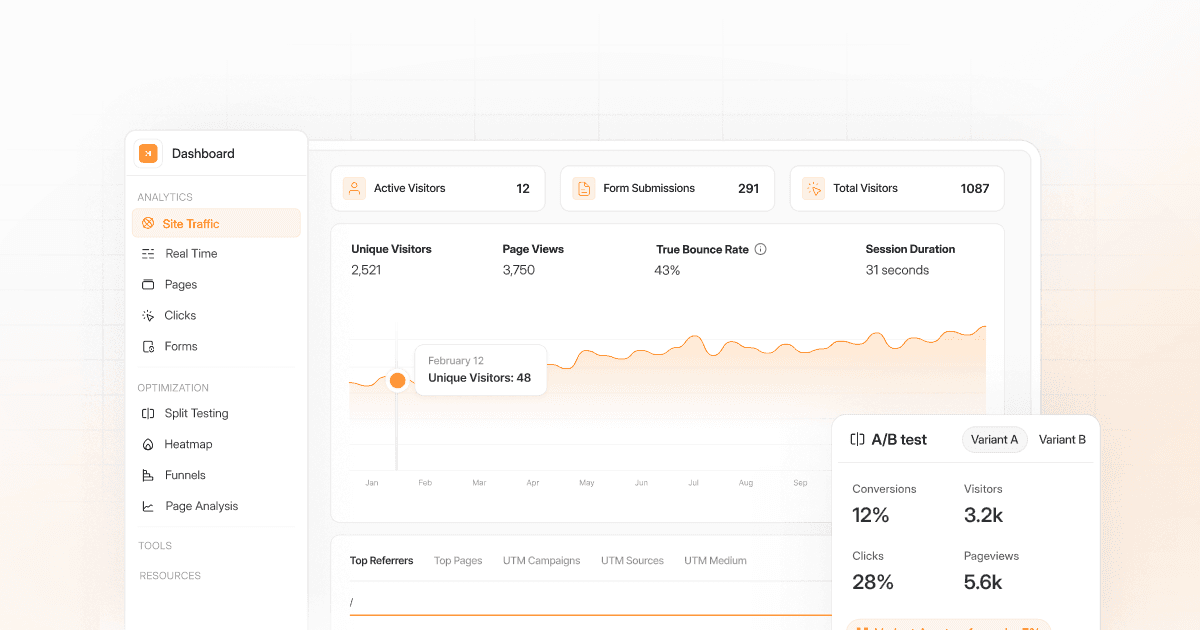
We detected 199 companies using Pirsch and 9 customers with upcoming renewal in the next 3 months. The most common industry is Software Development (9%) and the most common company size is 11-50 employees (36%). We find new customers by detecting JavaScript snippets or configurations on customer websites.
Source: Analysis of Linkedin bios of 199 companies that use Pirsch
Company Characteristics
i
Shows how much more likely Pirsch customers are to have each trait compared to all companies. For example, 2.0x means customers are twice as likely to have that characteristic.
Trait
Likelihood
Country: DE
9.5x
Company Size: 51-200
3.8x
Company Size: 11-50
2.8x
Country: US
1.9x
I noticed that Pirsch users span an incredibly wide range of industries, but they share a common thread: they are operational businesses with a direct service or product offering. These aren't pure tech startups building the next unicorn. Instead, they're laser tag facilities in Belgium, roofing contractors in Texas, medical clinics in Berlin, fitness centers in New Mexico, urgent care chains, metal processors, law firms, schools, and niche manufacturers. Many are B2B service providers like business consultancies, executive search firms, and logistics companies. Others are consumer-facing businesses like restaurants, beauty schools, bakeries, and retail operations. What strikes me is how grounded these companies are in real-world operations rather than abstract platforms.
These are established, revenue-generating businesses. While a handful show seed or Series A funding, the vast majority appear to be bootstrapped or traditionally financed operations. Employee counts cluster in the 11-50 and 51-200 ranges, with many showing no funding information at all. This tells me they're past the scrappy startup phase but aren't massive enterprises either. They're in that middle zone where they need professional tools but aren't shopping for enterprise sales cycles.
🔧 What other technologies do Pirsch customers also use?
Source: Analysis of tech stacks from 199 companies that use Pirsch
Commonly Paired Technologies
i
Shows how much more likely Pirsch customers are to use each tool compared to the general population. For example, 287x means customers are 287 times more likely to use that tool.
I noticed that Pirsch users tend to be privacy-conscious, design-forward companies that prioritize lightweight, modern tooling. The strong correlation with Webflow immediately signals these are often startups or small teams building marketing sites without heavy engineering resources. They're choosing best-of-breed tools rather than all-in-one platforms, which tells me they value flexibility and actually think carefully about their stack.
The pairing of Pirsch with Postmark is particularly revealing. Both tools share a philosophy: do one thing exceptionally well with a clean, developer-friendly approach. Companies using both are likely technical enough to appreciate good APIs and documentation, but they're not building everything custom. The gaug.es correlation reinforces this pattern too. It's another privacy-focused, minimalist analytics tool, suggesting these companies either migrated from gaug.es to Pirsch or run both while evaluating alternatives.
The 1Password Data Breach Scanner appearing 52 times more frequently than average shows these companies take security seriously despite being small. Combined with Google Search Console's strong presence, I'm seeing teams that care about technical SEO and proper site hygiene. The HubSpot Marketing Hub correlation suggests they're doing content marketing at scale and need real marketing automation, not just email capture forms.
Alternatives and Competitors to Pirsch
Explore vendors that are alternatives in this category
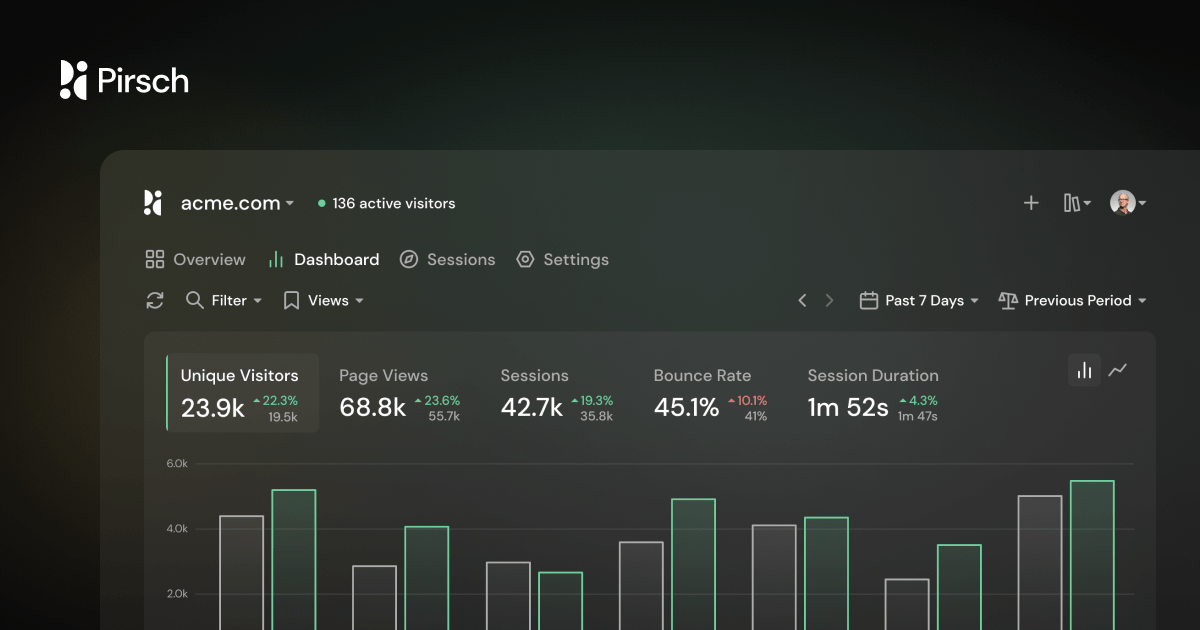 We detected 199 companies using Pirsch and 9 customers with upcoming renewal in the next 3 months. The most common industry is Software Development (9%) and the most common company size is 11-50 employees (36%). We find new customers by detecting JavaScript snippets or configurations on customer websites.
 Lowther Forestry Group Ltd
 Kongehuset / The Royal House - The Kingdom of Denmark
 FDSC - Fundația pentru Dezvoltarea Societății Civile
 RATISBONA Handelsimmobilien
 Lombiq Technologies
 The John Stewart Company
 PipPenguin
 CAW groep
 Best Manufacturing, Inc.
 MidWest Materials, Inc.
 Bersa S.A.
 SoilView, LLC
 We-R | Agence Webflow
 MILJO
MILJO
 Irish Yogurts
 Cineplex Deutschland GmbH & Co. KG
 Cosmetic Skin & Laser Center
 Poppy & Peep Chocolate
 Lasermagic
 coachbetter.com