We dug into our own data to find out how ecommerce companies and Shopify stores are using Klaviyo. Here are some real-world examples of companies using Klaviyo.
Online Retail - Hamburg, Germany
Pammys is Europe's fastest-growing footwear brand, reaching over a million customers in its first four years.
Pammys primarily uses Klaviyo for product launch marketing and list segmentation. When they dropped a retro sneaker line, they set up a dedicated signup form to capture interested subscribers, tag them to that specific launch, and notify them the moment the sale went live. They also keep deal-seekers on a separate list, using a standalone form on their discount codes page rather than mixing those signups into the main newsletter audience.
Email and SMS consent both sync back to Shopify, keeping marketing permissions consistent across both platforms.
It's a lean setup, but the intentionality stands out: rather than dumping everyone into one list, Pammys is already thinking about why different subscribers signed up and what they actually want to hear about.
Entertainment - United States
Beat The Bomb is an immersive group entertainment company where teams suit up in hazmat gear and work through interactive game rooms before facing a paint or foam explosion. With locations across the US and a virtual team-building platform, they've hosted over 300,000 players, primarily corporate groups, birthday parties, and school outings.
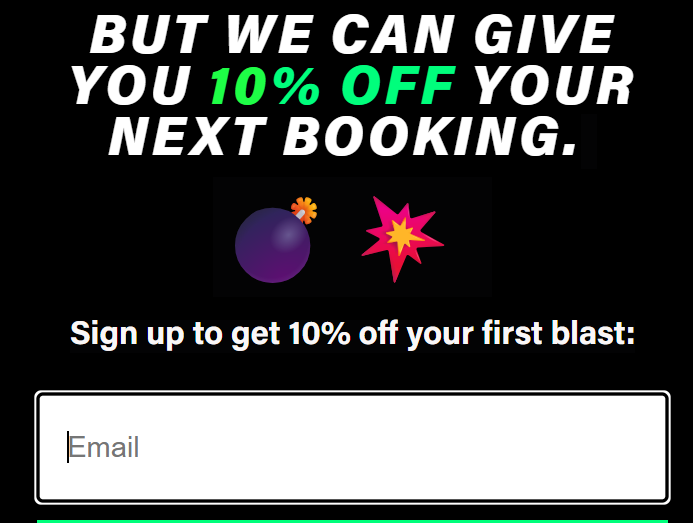
Beat The Bomb uses Klaviyo for location-based marketing, customer retention, and event-driven acquisition. Each physical location has its own dedicated email list, so they can send relevant communications to players in Brooklyn, Atlanta, DC, Houston, Philadelphia, Denver, and Charlotte without blasting everyone with the same message. Their main popup offers 10% off a first booking to capture new subscribers, with an SMS upsell on the second step.
They also use Klaviyo forms creatively for event partnerships. A form tied to a DreamHack gaming festival signup reveals a unique 25% discount code on confirmation, making Klaviyo the mechanism for both registration and discount delivery in a single flow.
What's most interesting about Beat The Bomb is the depth of their Klaviyo use relative to their size. They've built Klaviyo CDP into the center of their customer data strategy, connecting booking systems and event activity to create a unified view of each player. For an entertainment company of this scale, that's unusually sophisticated.
Wellness & Supplements - United States
Happy Mammoth sells women's health supplements focused on gut, hormonal, and weight health.
Happy Mammoth uses Klaviyo for interest-based segmentation, email and SMS acquisition, product waitlists, and post-purchase SMS. Their signup popup asks visitors to choose their biggest health concern before giving their email, saving that preference as a profile property that shapes what emails they receive going forward. Email and SMS are collected in a single two-step flow, with SMS consent syncing back to Shopify.
They also use Klaviyo to build waitlists for new product launches, keeping those subscribers in a separate list from the main audience. And their order tracking tool, Wonderment, plugs directly into Klaviyo to collect phone numbers after purchase, so customers can receive shipping updates via text.
The segmentation-at-signup approach is the standout here. Most brands ask what you want after you subscribe; Happy Mammoth asks before, which means their first email can already be relevant rather than generic.
Wellness & Fitness - United States
EōS Fitness is a fast-growing gym chain with 225+ locations across the US, offering premium facilities at accessible price points. With a membership model where churn is the central business challenge, their marketing stack is built around the full member lifecycle from prospect to long-term retention.
EōS uses Klaviyo as their email and SMS marketing execution layer, running it on top of Amperity as a dedicated customer data platform. Amperity handles the heavy lifting of unifying member data from in-club systems, digital touchpoints, and app activity across hundreds of locations. Klaviyo then takes that clean, unified data and powers the actual communications: prospect conversion sequences, onboarding flows, engagement nudges, retention campaigns, and win-back programs.
Running a dedicated CDP alongside Klaviyo rather than relying on Klaviyo alone reflects the scale and complexity of the operation. At 225+ locations with members interacting across digital and physical channels, keeping data clean and consistent is a problem that needs its own tool. Klaviyo handles the messaging side exceptionally well; Amperity handles the data side. It's a sensible division of labor.
AI Hardware & Software - United States / Singapore
Plaud makes AI-powered note-taking devices and apps, with over 1.5 million users worldwide. Their products are physical hardware that captures and transcribes audio with AI. With a $250M revenue run rate achieved in just three years, Plaud has built a genuinely global customer base across consumer and professional markets.
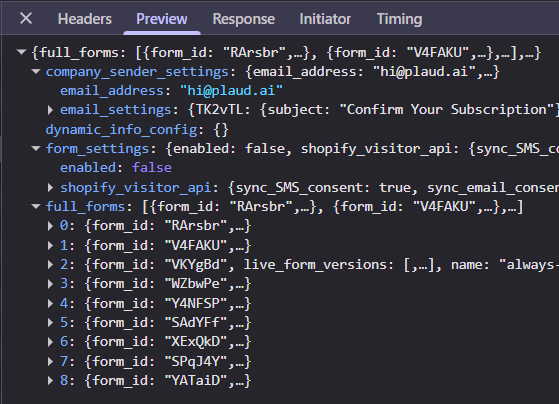
Plaud uses Klaviyo across an unusually wide range of use cases for a hardware company. On the consumer side, they run an evergreen popup offering a mystery gift on signup. They also have a dedicated form targeting healthcare professionals specifically, offering 600 free transcription minutes as the incentive. For enterprise prospects, a separate B2B contact form collects job title, company, industry, and product interest, feeding a distinct sales list. There's also a product launch waitlist form for new hardware releases, and several ad landing page forms with their own lists, one of which is named in Chinese, suggesting deliberate separation of Chinese-language ad traffic.
Beyond acquisition, Plaud is building Klaviyo into their broader growth platform as a foundation for lifecycle messaging, audience segmentation, and eventually push notifications. Rather than treating Klaviyo as just an email tool, they're architecting it as a scalable marketing infrastructure layer. The Klaviyo customer hub is also active on their Shopify store, with wishlists and Smile.io loyalty connected.
For a hardware company still in its early growth phase, this is a notably mature and well-structured Klaviyo setup. Most companies at this stage are still figuring out basic list hygiene; Plaud is already thinking about channel expansion and platform architecture.
Wholesale - United States
Restaurant Supply is an online wholesaler of commercial kitchen equipment and foodservice supplies.
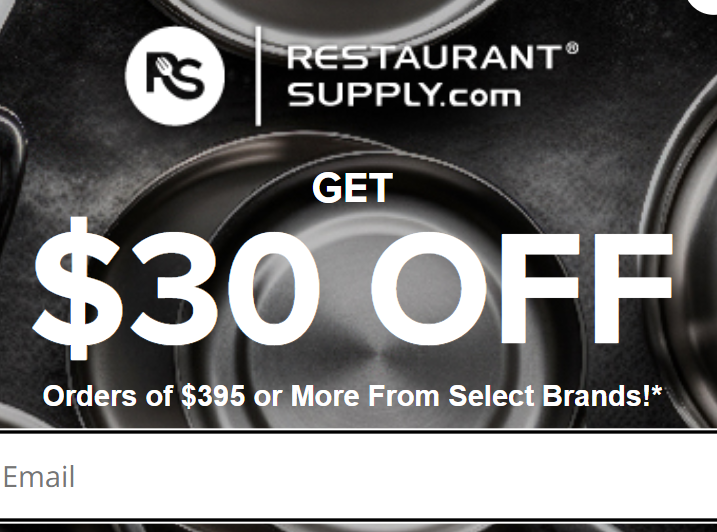
Restaurant Supply uses Klaviyo primarily for email and SMS list building and B2B lead generation. Their main popup offers a $30 discount on qualifying orders, collecting email first and then asking for a phone number on a second step. They run separate versions of this flow for desktop and mobile, both restricted to North American visitors.
They also use Klaviyo to capture leads for FusionPrep, their private label product line. A dedicated form on the FusionPrep page captures visitor interest and tags each submission so a sales rep can follow up directly, effectively turning Klaviyo into a lightweight B2B lead routing tool.
Using the same platform for both consumer email capture and B2B sales lead generation is an interesting choice. It keeps everything in one place, though it does require discipline around list separation to avoid mixing audiences.
Health & Wellness - United States
Charlotte's Web is one of the most recognized CBD brands in the US, known for its hemp-derived wellness products ranging from oils and gummies to topicals.
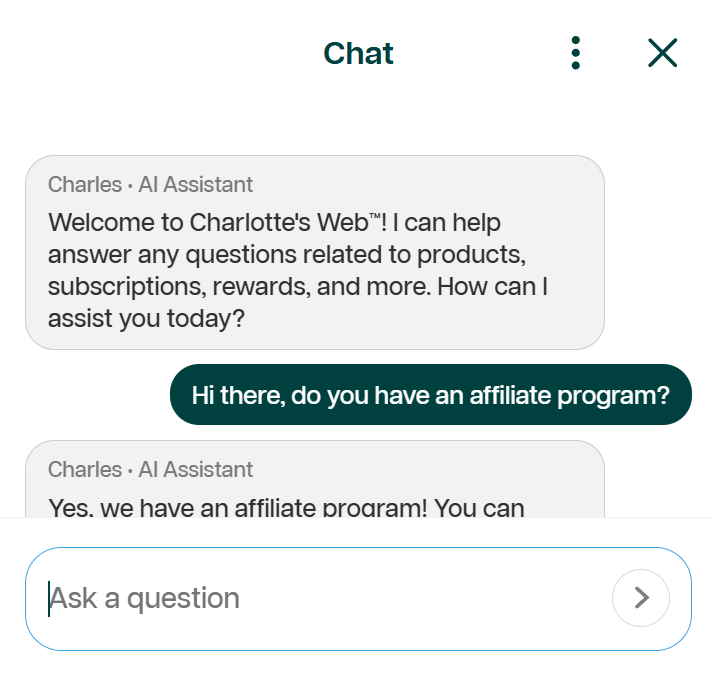
Charlotte's Web uses Klaviyo for AI-powered customer support, on-site customer experience, and email and SMS acquisition. Their AI chat assistant, Charles, handles customer questions in real time directly on the site, covering products, subscriptions, rewards, and account management. That same widget doubles as a customer hub, giving logged-in shoppers access to orders and wishlists, with email and SMS marketing prompts woven in so consent capture feels like part of the account experience rather than an interruption.
SMS sign-up is also surfaced as a dedicated content block within the hub, with early sale access and exclusive offers as the hook.
Charlotte's Web is one of the more complete examples of Klaviyo being used as a full customer experience layer rather than just a marketing tool. The combination of AI chat, account hub, and consent capture in one place is something most brands are still assembling from separate tools.
Outdoor Gear - United States / Australia
Sea to Summit makes technical outdoor gear for backpackers, paddlers, and overlanders.
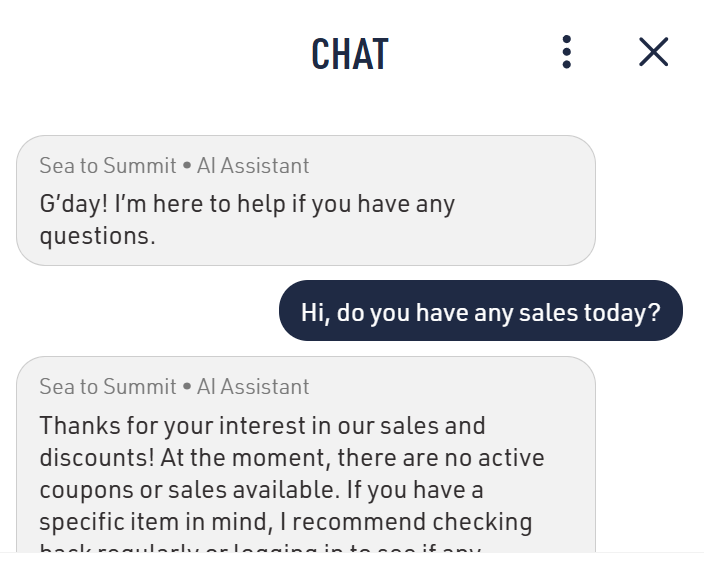
Sea to Summit uses Klaviyo for email and SMS acquisition, activity-based segmentation, retailer list management, and AI-powered customer support. Their main signup popup collects email and immediately offers an additional discount for adding a phone number, running email and SMS capture as a single two-step sequence. There's also a dedicated form just for existing email subscribers who haven't yet opted into SMS.
Their product landing pages each have their own embedded signup form that captures the visitor's activity preference, such as backpacking or overlanding, at the point of signup. That preference is saved to their profile so segmentation starts from the very first touchpoint. A separate retailer-facing form collects organization and location data into a distinct list, keeping B2B and consumer audiences cleanly separated.
The activity preference capture at signup is the standout. It's a small thing operationally, but it means every new subscriber enters the list with a meaningful tag that can shape every subsequent communication. That kind of upstream data hygiene compounds over time.
Food & Beverage - Australia
The Jerky Co is an Australian air-dried meat brand with physical retail stores across WA, NSW, and VIC, as well as an online shop.
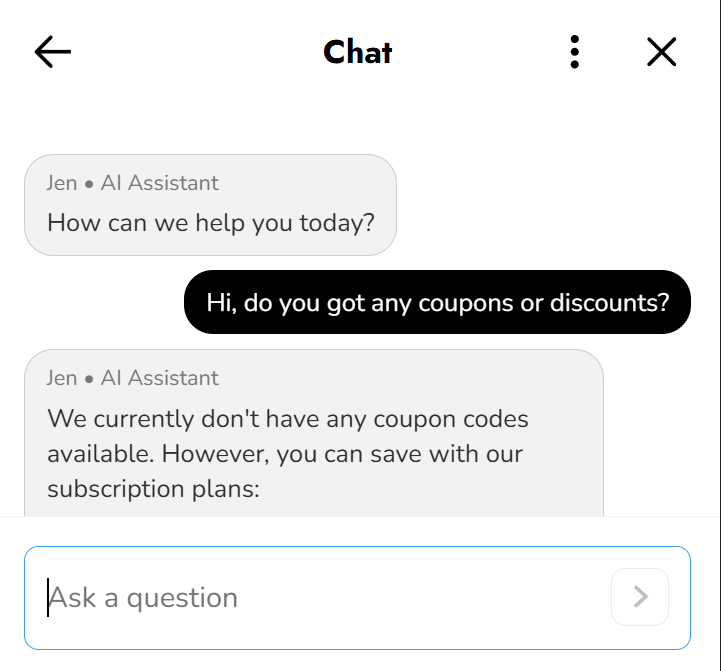
The Jerky Co uses Klaviyo for online and in-store list building, geo-segmented retail campaigns, email preference management, and AI-powered customer chat. Their setup is notable for how cleanly it separates channels: forms are explicitly labeled for online versus retail contexts, making it easy to know where each subscriber came from.
Online visitors get a standard welcome popup with a discount code. On the retail side, customers who scan a QR code on their receipt land on a form that collects their preferred snack type and local store, tagging them to a specific location from the start. State-specific competition forms are locked to their own URLs, so a NSW promotion only shows to NSW participants. Both email and SMS consent sync back to Shopify.
They also run a preference center where subscribers can opt out of specific holiday email categories like Father's Day or Valentine's Day and update their product preferences, giving customers genuine control over what they receive.
The combination of location-tagged retail signups, state-level competition forms, and a real preference center puts The Jerky Co well ahead of most brands their size in terms of list hygiene and subscriber experience.
Food & Beverage - United States
Perdue Farms is one of the largest family-owned food companies in the US, operating brands across poultry, premium meats, and organic products.
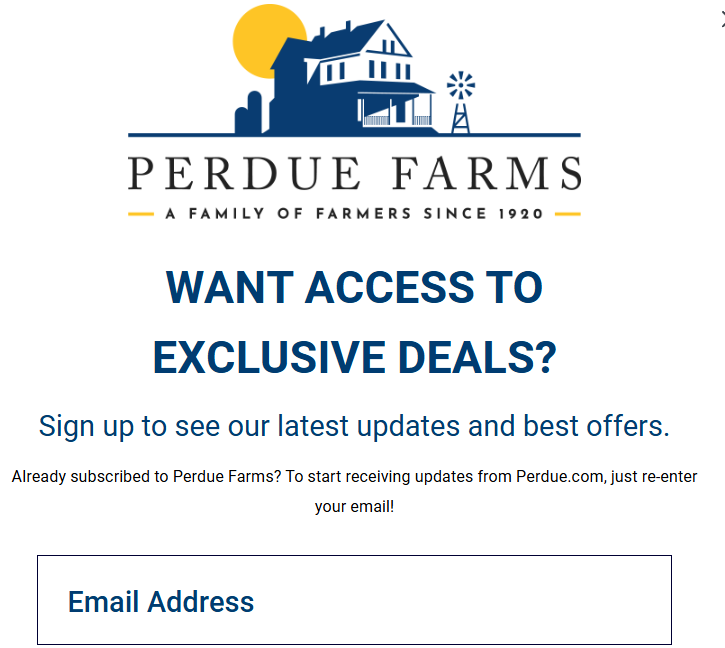
Perdue Farms uses Klaviyo for email and SMS acquisition, cross-brand list building, consumer segmentation, and B2B newsletter management. Their main popup collects email first and then asks for a phone number to opt into SMS, with a clear skip option. The consent copy explicitly covers both perduefarms.com and perdue.com, which is a thoughtful acknowledgment that consumers may only recognize one of the two brand names.
They also run a standalone newsletter form that collects name, zip code, and date of birth alongside email, feeding into segmentation and birthday campaigns. A separate embedded form on their corporate site feeds its own distinct list, keeping consumer and B2B audiences cleanly divided.
Managing multiple brand audiences under one Klaviyo account while keeping the lists properly separated is harder than it sounds. Perdue Farms handles it well, and the cross-brand consent copy is a small but genuinely unusual detail.
Online Retail - United States
Stein Mart is an American off-price retailer relaunched as an online brand after its brick-and-mortar stores closed, now operating through steinmart.com.
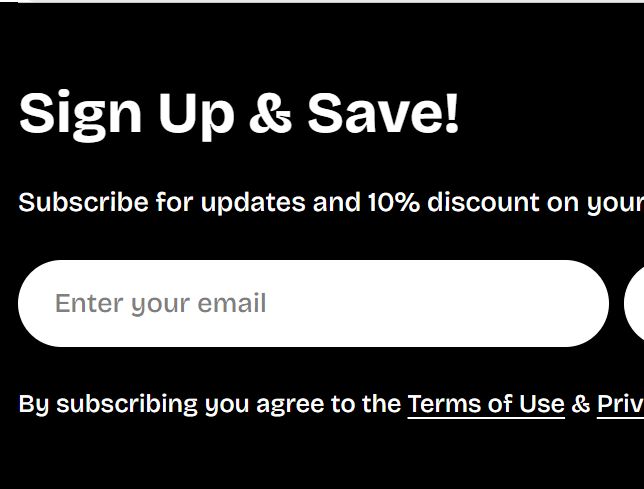
Stein Mart uses Klaviyo for email and SMS acquisition and for converting existing email subscribers into SMS subscribers. Their main popup offers 10% off in exchange for an email, then immediately presents an SMS opt-in step pitching drops, sales, and live shopping updates. Both email and SMS consent sync back to Shopify.
They also run a separate inline SMS collection form aimed specifically at subscribers who are already on the email list but haven't given their phone number yet. This form uses a one-time code to verify the number before completing the opt-in, adding a layer of quality control to the SMS list.
The two-form strategy, one for new subscribers and one for upgrading existing ones, is a smart way to maximize SMS list growth without over-interrupting people who are already engaged. It's a simple idea that a surprising number of brands don't bother to implement.

 Project Arete
 spike
spike
 Meal Prep Ottawa
 carobme
 By Bella
 ARENA ROJA
 Ravenhill Studio
 SKETCH
 Charli London
 The Hair Vixens
 The Kratom King
 Wool Valley
 Vettex Sports, Inc.
 UM | Shopify Marketing Agency
 Links
Links
 Juji Club
 THOMAS BIRD SHOES LIMITED
 KMB Shoes
 AIRTANG
 Pammys
 Beat The Bomb
 Happy Mammoth
 EōS Fitness
 Plaud
Plaud
 Restaurant Supply
 Charlotte's Web
 Sea to Summit
 The Jerky Co
 Perdue Farms
 Stein Mart