We detected 3,207 companies using Rapid Search and 119 customers with upcoming renewal in the next 3 months. The most common industry is Retail (69%) and the most common company size is 2-10 employees (75%). We find new customers by detecting JavaScript snippets or configurations on customer websites.
Note: We can't detect companies that use Rapid Search with a headless implementation or backend search
📊 Who usually uses Rapid Search and for what use cases?
Source: Analysis of job postings that mention Rapid Search (using the Bloomberry Jobs API)
Job titles that mention Rapid Search
i
Based on an analysis of job titles from postings that mention Rapid Search.
Job Title
Share
Software Engineering Manager
22%
CODIS Subject Matter Expert
17%
Backend Engineer
11%
Regional Sales Director
6%
I noticed that Rapid Search buyers span two distinct domains. About 28% are sales and marketing leaders (Regional Sales Directors and SEO Directors) making strategic decisions about customer acquisition and search visibility. The majority, however, are technical leaders, with Software Engineering Managers (22%) and specialized CODIS Subject Matter Experts (17%) driving purchasing decisions. These technical buyers prioritize scalable data infrastructure, with engineering managers focused on building platforms that handle massive volumes of cybersecurity telemetry and require robust search capabilities across billions of records.
The day-to-day users are primarily backend engineers, data platform specialists, and forensic analysts. Backend engineers work with large datasets using tools like Elasticsearch and OpenSearch, building systems that demand what one posting calls "efficient data formats and structures for large amounts of spatially enabled data optimized for rapid search." CODIS experts execute various search types including AutoSearcher, Batch Searcher, and Rapid Search Requests for DNA database management. Security analysts use these tools for threat detection and investigation across extended data retention periods.
The core pain point is speed at scale. Companies need "365 days of 'hot' data for rapid search and investigation" to detect threats faster. Multiple postings emphasize "rapid search and retrieval across large datasets" and "rapid search and analytics at scale" as critical capabilities. One GIS posting specifically seeks solutions for "finding the best candidate amongst billions of candidate records," revealing that organizations struggle with search performance as data volumes explode across security, genomics, and location-based applications.
👥 What types of companies use Rapid Search?
Source: Analysis of Linkedin bios of 3,207 companies that use Rapid Search
Company Characteristics
i
Shows how much more likely Rapid Search customers are to have each trait compared to all companies. For example, 2.0x means customers are twice as likely to have that characteristic.
Trait
Likelihood
Industry: Apparel & Fashion
13.6x
Industry: Retail Luxury Goods and Jewelry
10.4x
Industry: Retail Apparel and Fashion
9.1x
Country: IN
1.6x
Country: AU
1.1x
I noticed that Rapid Search's customers are overwhelmingly product-focused retailers and direct-to-consumer brands. These aren't SaaS companies or service providers. They're selling physical goods: furniture, jewelry, skincare, sporting equipment, baby products, camping gear, kitchen supplies, pet accessories. Many operate in the "affordable luxury" or "premium accessible" space, offering yoga pants, custom cycling saddles, commercial espresso machines, Korean beauty products, outdoor apparel. A significant portion manufacture or design their own products rather than just reselling others.
Most of these companies are small to mid-sized, sitting in that 2-50 employee range with a few outliers up to 200. Very few show venture funding, and when they do, it's modest seed rounds or equity crowdfunding. They're past the pure startup phase but haven't scaled to enterprise size. They have established brands, real customers, and working business models. They're at the stage where they need professional tools but don't have enterprise budgets or IT teams.
🔧 What other technologies do Rapid Search customers also use?
Source: Analysis of tech stacks from 3,207 companies that use Rapid Search
Commonly Paired Technologies
i
Shows how much more likely Rapid Search customers are to use each tool compared to the general population. For example, 287x means customers are 287 times more likely to use that tool.
I noticed that Rapid Search users are predominantly e-commerce companies running on Shopify, and they're clearly focused on optimizing the customer shopping experience. The overwhelming presence of Shopify (2,901 companies) combined with multiple review platforms and loyalty tools tells me these are direct-to-consumer brands that need sophisticated site search functionality to help customers find products quickly.
The pairing with Searchanise is particularly telling since both tools focus on search functionality, suggesting these companies see on-site search as critical enough to warrant multiple solutions or testing alternatives. The strong correlation with Klaviyo makes perfect sense because once you improve product discovery through better search, you need robust email marketing to bring customers back. Stamped.io and Judge.me appearing together indicates these brands rely heavily on social proof and customer reviews to drive conversions. They understand that after helping shoppers find the right product, they need reviews to seal the deal.
Looking at the full picture, these companies operate with a marketing-led approach. They're investing in the entire customer journey: search to help with discovery, reviews to build trust, and email marketing to drive retention. The presence of Uppromote suggests they're also leveraging affiliate and referral programs for customer acquisition. This stack points to growing e-commerce brands, likely past the early startup phase but still scaling aggressively. They have enough traffic to justify optimizing search and enough customers to make review collection and email marketing worthwhile.
Alternatives and Competitors to Rapid Search
Explore vendors that are alternatives in this category
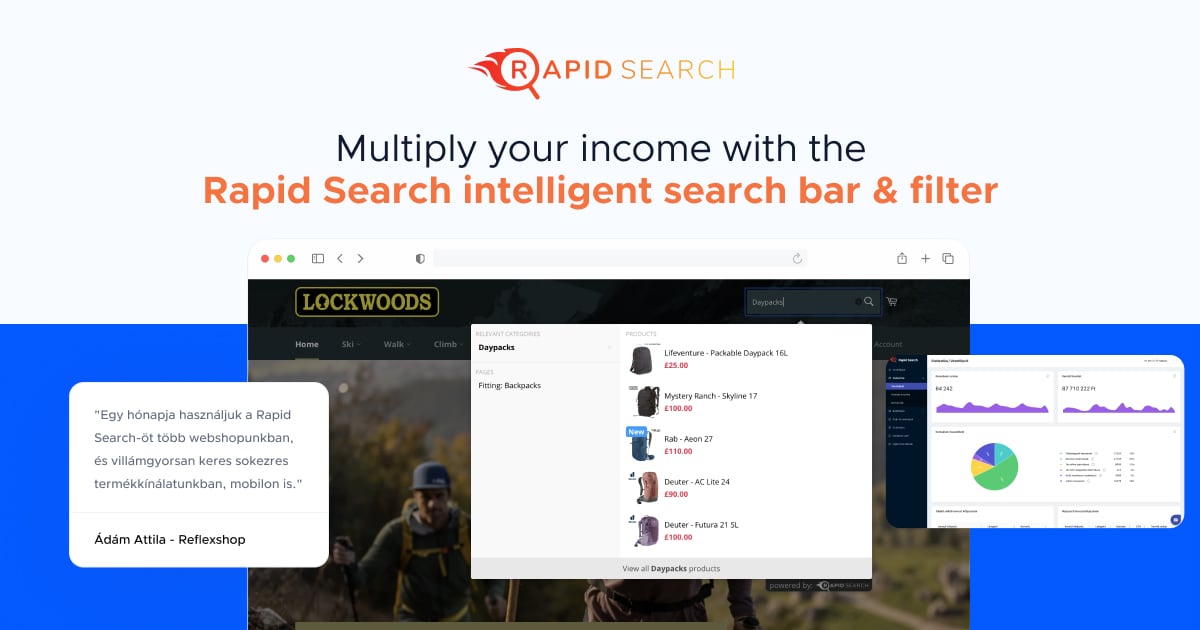 We detected 3,207 companies using Rapid Search and 119 customers with upcoming renewal in the next 3 months. The most common industry is Retail (69%) and the most common company size is 2-10 employees (75%). We find new customers by detecting JavaScript snippets or configurations on customer websites.
Note: We can't detect companies that use Rapid Search with a headless implementation or backend search
We detected 3,207 companies using Rapid Search and 119 customers with upcoming renewal in the next 3 months. The most common industry is Retail (69%) and the most common company size is 2-10 employees (75%). We find new customers by detecting JavaScript snippets or configurations on customer websites.
Note: We can't detect companies that use Rapid Search with a headless implementation or backend search
 Creepers Socks
 Vintage Menu Art
 WOODstack
 donclickin
 OKG Jewelry
 NORTHSTAR APPAREL COMPANY
 Foxy
Foxy
 Vegan Grocery Store
 DMS Engineering
 brobrobrille.no
 Blue Moose Art Gallery
 INNOVV TECH
 FIRE ELF
 nomadic artisan
 Zamage
 Stoltzfus Meats
 Boutique SP
 Mlada
Mlada
 Digicentro


