

Most GTM teams look at B2B integrations and think: engineering decision.
But any company that built a Slack or Zapier integration, or an app on the HubSpot App Marketplace or Salesforce App Exchange, has made a deliberate, technical, go-to-market commitment. That took real investment, time, and effort.
That commitment is one of the strongest public signals about how a company operates, sells, and grows. It tells you something about their tech stack. And on top of all that, this signal is observable and free.
I decided to pull data on over 13,000 companies that have made exactly that commitment across 4 major ecosystems: Slack, Zapier, Hubspot and Salesforce.
I mapped them against company size, industry, and tech stack. And I tried to answer a simple question: what does ecosystem presence in each of these 4 ecosystems actually tell us about a company and how they operate?
Here’s what I found.
Finding 1: Most companies are betting on one ecosystem only.
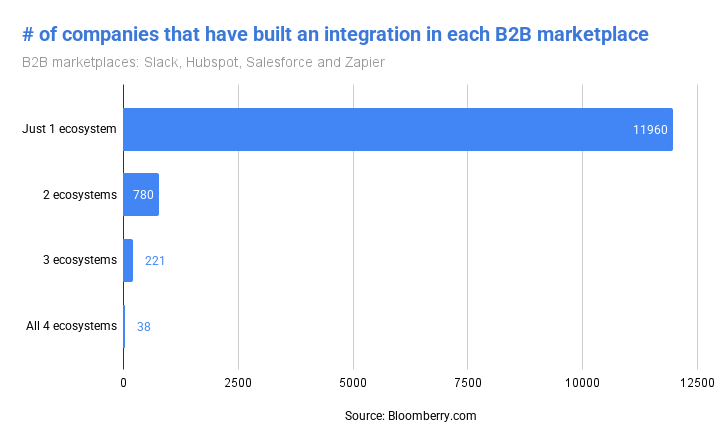
First off, of the 13,000+ companies that have made the commitment to build for a B2B ecosystem, 92% have done it in exactly one place. Only 6% have built for two ecosystems. Just 1.7% for three.
And the # of companies that have gone all-in on all four across Zapier, Slack, HubSpot, and Salesforce? Just 38 unicorns.
The conventional wisdom is that modern SaaS companies integrate everywhere, or at least for more than 1 platform. But the data says otherwise. For the vast majority, ecosystem strategy means picking one platform and planting a single flag.
So what do the companies that go wide actually look like?
The 38 companies on all four platforms are names most people in tech or sales recognize: Gong, DocuSign, Salesloft, RingCentral, Pendo, Chargebee, Vidyard, ZoomInfo, PandaDoc. Established, category-defining SaaS companies that have been building their ecosystem presence for years.
The three-platform club is broader but follows a similar profile. Apollo, Asana, Intercom, Miro, Monday, Okta, ClickUp, Gainsight, Hotjar. Companies well past product-market fit, actively investing in being embedded in their customers’ workflows.
And in both groups, ecosystem breadth correlates with company maturity. The further along a company is in its growth journey, the more ecosystems it tends to occupy.
Finding 2: Each ecosystem attracts a completely different company size + funding stage
Not all ecosystems are created equal. When you look at the types of companies that have built for each one, you’ll see 4 distinct company profiles.
Zapier is where early stage companies build for. The most overrepresented companies are small, between 2 and 50 employees, and overwhelmingly Seed or Series A funded.
This makes sense when you think about who Zapier’s core user is: small, scrappy teams that automate their workflows because they don’t have the headcount to do things manually. The companies building for Zapier are naturally targeting that same audience. Small companies building for small companies.
There are some huge companies like Snowflake, and Docusign, with Zapier integrations, but they are the exception, not the rule.
Companies that build Hubspot integrations follows a nearly identical size and funding profile to Zapier, with the heaviest concentration in companies between 2 and 50 employees at Seed and Pre-seed stage. But the similarity stops there.
While companies that build for Zapier skews heavily toward US-based software companies, HubSpot’s ecosystem is notably more international.
And unlike Zapier, where the common thread is automation and developer tooling, the companies building for HubSpot are almost all selling to sales and marketing teams.
Baremetrics tracks subscription revenue. Chatbase builds AI chatbots for customer-facing teams. Showpad helps sales reps manage content. DemandFarm maps account relationships inside CRM. Their customers spend their day inside HubSpot, so that is where these companies built.
The companies building for Slack is not dramatically different from HubSpot’s. The concentration is still heaviest in the 11 to 200 employee range. But the type of company is completely different.
Zapier attracts tools built for small scrappy teams trying to do more with less. Slack attracts tools built for technical teams inside more mature organizations: engineering workflows, developer infrastructure, security operations.
Companies that have built a Slack integration, such as Datadog, Sentry, Mixpanel, Retool, Databricks, Snyk, and Tableau are not tools for a 5 person startup. Of course, there are exceptions, but we’re looking at the *typical company* building for Slack.
Generally speaking, companies with Slack integrations are products that get evaluated by engineering leads and ops teams at companies that have already figured out their core infrastructure and are now building on top of it.
Lastly, companies that have build an app for Salesforce AppExchange are in a different category from the other three ecosystems. Getting listed requires passing a formal security review and meeting Salesforce’s certification standards. That bar filters out early stage companies still figuring out their product, or lean teams with very little resources.
The companies that make it through are the ones selling to enterprise buyers, organizations with procurement teams, IT departments, and long buying cycles. You see this in the caliber of companies on the list: Adobe, PayPal, Deloitte, Amazon, LinkedIn, Fidelity. These are not companies chasing scrappy startups. They are here because their buyers are here.
Finding 3: Each ecosystem has a distinct tech stack fingerprint.
The companies in each ecosystem don’t just share a similar size or funding profile. They also run remarkably similar tools. And those tools tell you something specific about how each group of companies goes to market.
Companies that have built a Zapier integration are 3.6x more likely to use Stripe, 3.2x more likely to use Amplitude, 9x more likely to use Rewardful, and 7.4x more likely to use FirstPromoter compared to the average software company.
For those unaware, Rewardful and FirstPromoter are affiliate and referral tracking tools, software that lets companies run partner and referral programs where others earn a commission for sending customers their way.
Together with Stripe for self-serve payments and Amplitude for product analytics, this is the classic product-led growth toolkit. These companies grow by letting users find them, try them, and pay without ever talking to sales.
The connection to Zapier makes sense when you think about it through that lens. PLG companies win by reducing every possible point of friction in their product. A user who can connect your tool to the rest of their stack in two clicks is a user who activates faster, gets value sooner, and churns less. Zapier is a part of how their product delivers value.
Companies that have built a HubSpot integration are 20x more likely to use Clay, 4.1x more likely to use Gong, 3.5x more likely to use HubSpot Marketing Hub itself, and 2.8x more likely to run LinkedIn Ads. At the same time they are 4.1x more likely to use Stripe and 2.4x more likely to use Intercom.
Clay is an outbound prospecting tool, while Gong records and analyzes sales calls. LinkedIn Ads drives paid inbound traffic, while HubSpot Marketing Hub handles content, email, and lead nurturing. So it seems companies that build HubSpot integrations/apps aren’t betting on just 1 channel. They are running multiple channels at once.
Companies that have built a Slack integration are 19.7x more likely to use Clari, 14.9x more likely to use Chili Piper, 13.6x more likely to use Outreach, and 11x more likely to use Gong.
Unlike HubSpot builders who run a mix of inbound, outbound, and self-serve, the Slack stack has no strong self-serve signals. No Stripe. No LinkedIn Ads. These are companies that have made a deliberate bet on sales as their primary growth motion and built their entire stack around making that motion run efficiently.
Companies that have built a Salesforce AppExchange app are 19.5x more likely to use Mindtickle, 16.7x more likely to use Gainsight, 15.1x more likely to use Highspot, 14.1x more likely to use Clari, and 11.2x more likely to use Pardot.
What separates this stack from Slack’s is what comes after the sale. Slack builders invest in closing deals. Salesforce builders invest in everything: hiring and training sales reps, enabling them with the right content, forecasting their pipeline, and then retaining and growing customers after they sign.
The tech stack for companies that build on Salesforce is what a full revenue org looks like: not just a sales team but an entire go-to-market machine built for long sales cycles and large accounts.
Finding 5: Zapier is the gateway ecosystem.
Of the 800 or so companies that have committed to two ecosystems, the most common combination by far is Zapier and Slack, with 679 companies. Zapier and HubSpot comes second with 515. Every other combination drops off significantly.
When companies decide to expand beyond their first ecosystem, Zapier is almost always one of the two. It is the most common pairing with Slack, the most common pairing with HubSpot, and the most common pairing with Salesforce.
This makes sense when you think about what Zapier is. It is the lowest barrier ecosystem to build for. The integration is relatively straightforward, the audience is broad, and the use cases are flexible. For a company dipping its toe into ecosystem strategy for the first time, Zapier is the natural starting point.
What is interesting is what companies pair Zapier with. Zapier plus Slack suggests a technical, developer-facing product expanding into the workflow automation space. Zapier plus HubSpot suggests a sales and marketing tool broadening its reach. The second ecosystem a company chooses tells you a lot about where they are trying to grow next.
So what does this mean for GTM teams?
A company’s ecosystem presence is not just a technical footnote. It is a window into how they operate, how they sell, and what they need next.
If a company has built a Zapier integration, they are almost certainly running a product-led growth motion. They are small, early stage, and growing without a large sales team.
The right companies to sell to them are tools that support that motion: product analytics, referral and affiliate platforms, lightweight customer support, and onboarding tools.
And the right sales approach is low-touch and high-velocity. The buyer is likely a founder or product lead, not a procurement committee.
If a company has built a HubSpot integration, they are running a hybrid motion. Inbound marketing driving leads, a sales team closing them, and often a self-serve track running in parallel.
The right companies to sell to them are demand generation tools, lead enrichment platforms, sales engagement software, and anything that sits in the marketing and sales workflow. A mid-market AE who can run a proper evaluation will land well here.
If a company has built a Slack integration, they have a serious inside sales team. They already use Gong, Clari, and Outreach. They know what good sales looks like and they will respond to a sharp, well-researched outbound sequence.
The right companies to sell to them are sales execution tools, revenue intelligence platforms, pipeline management software, and security and compliance tools. An AE who knows their stack and can speak to pipeline and forecasting will get their attention.
If a company has built a Salesforce AppExchange app, they have a full revenue org. Sales training, customer success, marketing automation, and enterprise procurement.
The right companies to sell to them are sales enablement platforms, customer success tools, revenue operations software, and enterprise marketing automation. This is a field sales motion. Long cycles, multiple stakeholders, and a business case that needs to be built. Don’t send a cold email, send your closer 🙂